On 13 July 2026, Gibraltar’s Prediction Market Regulations 2026 came into force, creating one of the first dedicated regulatory regimes for prediction markets. The regime places prediction market activity in its own category under the Gambling Act 2025, distinct from betting, gaming and lotteries. This piece sets out what the regulations actually require, where financial services rules still apply, and how the approach compares with Malta’s own developing position.

What the Gibraltar Prediction Market Regulations 2026 Actually Create
The regulations are subsidiary legislation, Legal Notice 2026/176, made under sections 34 and 159 of the Gambling Act 2025. They define a prediction market contract broadly: any contract, arrangement or instrument whose value, return, payment or settlement depends on whether an event occurs, or on an index, measure or outcome connected with that event.
The key drafting choice sits in regulation 4. Prediction market activity carried on under the regime is treated as a distinct activity for the purposes of the Gambling Act, and it is not to be treated as betting, gaming or a lottery solely because of its characteristics as prediction market activity.
A person who holds a prediction market authorisation and appears on the Authority’s register is exempt from the Act’s general prohibition on unlicensed gambling. That authorisation is a separate instrument from a licence under Part 4 of the Gambling Act, and holding one does not, by itself, bring a firm within the Act’s wider licensing provisions.
A Distinct Activity, Not Betting, Gaming or a Lottery
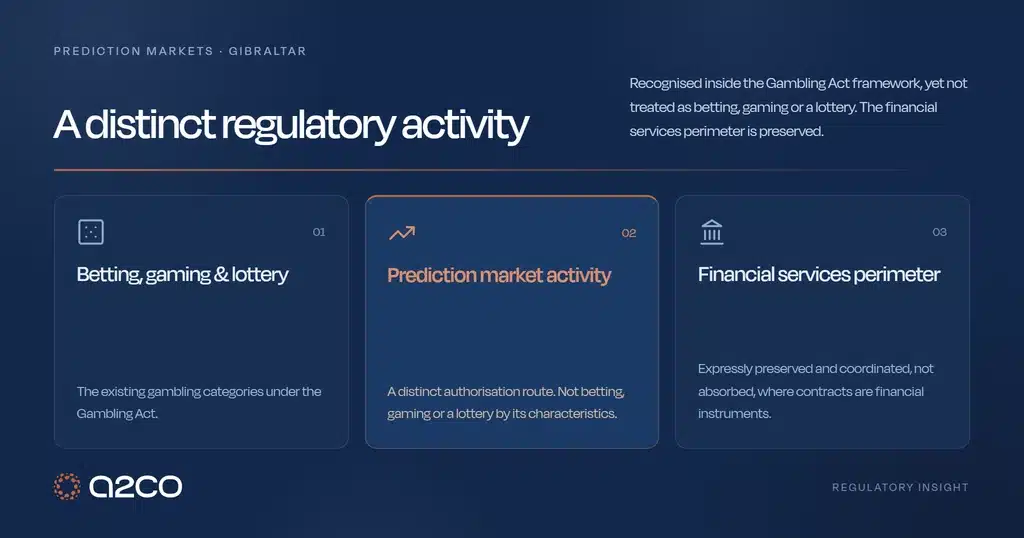
Gibraltar had three broad options available when it decided how to treat prediction markets. It could have folded them into existing betting, gaming or lottery categories. It could have left them entirely to the financial services perimeter. Instead, it created a third, distinct category: prediction market activity, authorised and supervised inside the Gambling Act’s structure, but governed by its own dedicated rules.
This matters because the regulations do not ask whether a product looks like gambling in the abstract. They ask whether the specific contract on offer can be objectively settled, whether it resists manipulation, and whether the operator running it can meet a defined set of ongoing standards. The label “prediction market” does the least work in this framework. The controls around the product do the most.
The Controls Gibraltar Is Actually Asking For
Once authorised, an operator is not left with a light-touch regime. The ongoing requirements include a number of market-style controls that go beyond conventional product approval, including market surveillance, manipulation prevention, conflicts management, participant disclosure, safeguarding and wind-down planning.
An authorised operator must maintain effective market integrity arrangements covering manipulation, wash trading, abusive concentration of positions and disorderly trading. It must manage conflicts of interest across its own trading, market making, liquidity provision, settlement sources and contract approval. It must give participants clear information about risk, fees, exposure and settlement, and assess whether a given participant should be trading a given contract at all.
Client money must be safeguarded and segregated. Operators need adequate financial resources and an approved recovery and wind-down plan. Anti-money laundering, sanctions and financial crime controls sit alongside these requirements, not instead of them. Gibraltar also expects a genuine substantive presence, and any outsourced material function has to be shown not to weaken supervision, integrity or participant protection.
Each class of prediction market contract must be approved by the Authority or certified under arrangements approved by the Authority before it is listed. Contract rules must specify participant eligibility, trading and order handling, suspension and delisting procedures, and an objective settlement source that is reliable, transparent and resistant to manipulation.
Where Financial Services Rules Still Apply
The Gibraltar Prediction Market Regulations 2026 do not remove the financial services perimeter. They coordinate with it.
A firm that already holds permission under Part 7 of the Financial Services Act 2019 does not need a separate prediction market authorisation, provided its prediction market contracts are financial instruments, the activity sits within its existing permission, and it keeps meeting the requirements attached to that permission. The Authority must consult the Gibraltar Financial Services Commission before applying any prediction market requirement to firms operating on this basis.
For a business starting from scratch, the position is less settled. The regulations do not spell out whether a prediction market authorisation alone will be sufficient wherever a product carries financial instrument characteristics, or whether Gibraltar Financial Services Commission permission will also be needed. Where a model has that kind of overlap, it is worth treating the classification question as open rather than assumed, and getting it tested before the product goes live.
Restricted and Prohibited Contracts
The Authority can prohibit or restrict any class of prediction market contract it considers contrary to the regulatory objectives or the public interest. The regulations name several categories directly: criminal conduct, death, serious injury, terrorism, war or armed conflict, and events that cannot be objectively settled at all. Contracts that carry a real risk of manipulation, disorderly trading, consumer harm or reputational risk to Gibraltar fall under the same power.
This lines up with where global regulators, including the CFTC in its own public discussions, keep landing on prediction markets. The sticking points are event eligibility, market integrity, manipulation risk and whether an outcome can actually be verified, not the label attached to the product.
How Gibraltar’s Approach Compares With Malta
Malta does not yet have a standalone prediction market regime. Instead, a prediction market model is assessed against Malta’s existing Malta Gaming Authority framework, model by model, alongside financial services rules where they are engaged. A2CO has set out Malta’s current position on prediction markets in more detail separately.
The practical difference is less about the underlying financial services analysis, which applies in both places, and more about how formally each jurisdiction has built the interaction into its rules. Gibraltar’s regulations expressly recognise the financial services perimeter and require consultation with the Gibraltar Financial Services Commission in defined circumstances. Malta’s position remains more case by case under the Malta Gaming Authority and the MFSA.
Market access is another real difference. Gibraltar sits outside the EU following Brexit, so a Gibraltar prediction market authorisation does not, by itself, provide access to EU markets. Malta is an EU member state, which may matter to an operator building an EU-facing product, though local gambling and financial services rules still need to be assessed on their own terms wherever users are actually based.
Who Is Already Regulated Under the New Regime
Two operators had already secured Gibraltar approvals before the regulations formally came into force. ADI Predictstreet, described as the official prediction market partner of the FIFA World Cup 2026, was licensed as a betting intermediary under Gibraltar’s previous gambling law in March 2026. WagerWire’s Wire Markets product was approved in principle in June 2026. Both now move across to be regulated under the dedicated regime.
Gibraltar’s Minister for Justice, Trade and Industry, Nigel Feetham KC MP, described the framework as a bespoke regime, the first of its kind anywhere in the world. Whether other jurisdictions follow Gibraltar’s structure, or continue to assess prediction markets under their existing gambling and financial services categories, remains to be seen.
What This Means for Operators Weighing Up Gibraltar and Malta
Neither jurisdiction offers a single answer that works for every prediction market model. The right starting point is the product itself, not the jurisdiction.
Operators comparing the two should work through: how the contract is structured and whether it could be treated as a financial instrument, whether target users sit inside or outside the EU, how far existing gaming licence categories in Malta might already cover part of the model, what a Gibraltar authorisation would and would not exempt the business from, and how AML, safeguarding and market integrity controls would need to be built out under either regime.
Crypto and stablecoin settlement adds a further layer. Gibraltar’s regulations expressly permit digital asset payments, including stablecoins, for funding participant accounts, providing collateral, settling transactions and making withdrawals, without changing the legal character of the underlying prediction market contract solely by reason of that payment method. For Malta, crypto-settled prediction market models would need to be assessed against the applicable gaming, financial services, crypto-asset and MiCA frameworks.
A2CO supports businesses active in, or exploring, prediction markets with regulatory pathway analysis, licensing strategy, compliance documentation and market integrity controls. Our focus is on helping operators assess the model, target markets and applicable regulatory frameworks before deciding on the most suitable route.