The Key Employee Initiative (KEI) in Malta is a fast-track Single Permit route for non-EU nationals hired into managerial or highly technical roles. Since 1 August 2025 the role must pay at least €45,000 gross a year, the employer must advertise it for two weeks first, and Identità aims to process complete applications within five to ten working days.
What the Key Employee Initiative Is and Who It Is For
The Key Employee Initiative Malta operates as a fast track within the normal Single Permit procedure. It is not a separate type of permit: the worker still receives a combined work and residence permit tied to one employer and one role, and Identità follows the regular Single Permit due diligence, only on a faster timetable.
It is aimed at third-country nationals who hold a job offer in Malta for a managerial or highly technical positions that requires relevant qualifications or adequate experience.
KEI Eligibility in 2026: Salary, Role and Evidence
Three conditions carry most of the weight in a KEI Malta application:
| Condition | What Identità expects |
|---|---|
| Salary | An annual gross salary of at least €45,000 |
| Role | A managerial or highly technical position requiring the relevant qualifications or adequate experience |
| Evidence | Certified copies of the relevant qualifications or proof of 3 years’ work experience relating to the job title one is applying for. |
The €45,000 figure took effect on 1 August 2025 under Malta’s Labour Migration Policy. Many guides still quote €30,000 or €35,000, which predate that change, so a salary benchmarked on older material can fail the test outright.
We recommend that the contract’s basic gross salary meets the threshold on its own, rather than relying on bonuses or allowances to reach it. Identità assesses the contract as submitted, and the job title, duties and salary need to match across every document in the file.
For qualifications, Identità’s general Single Permit guidance asks for certificates to be accompanied by recognition from the Malta Qualifications Recognition and Information Centre (MQRIC). Where a candidate relies on experience rather than a degree, reference letters need to evidence the relevant work clearly and the duration of the employment must also be specified in the letter.
The Two-Week Advert Employers Often Miss
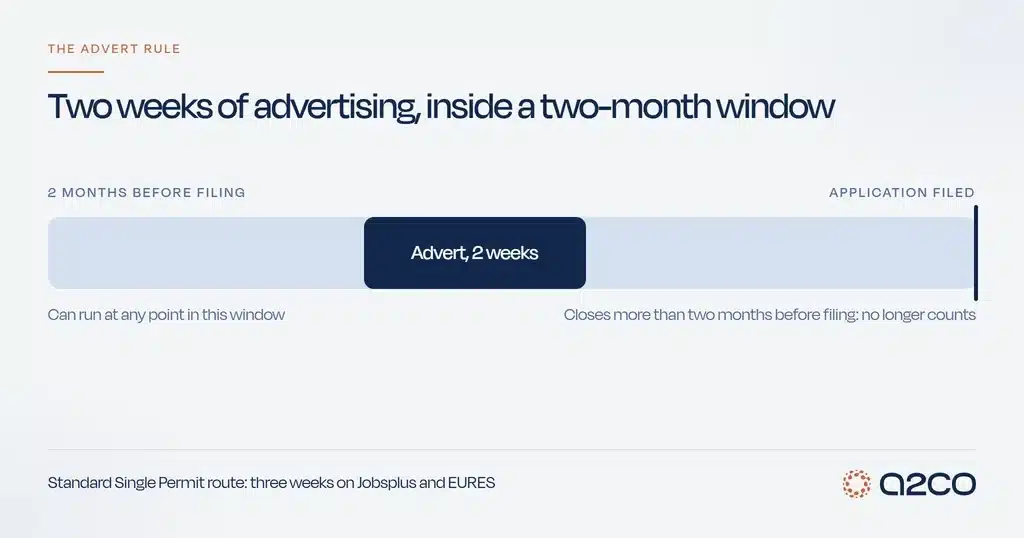
Since August 2025, every KEI application needs proof of one job advert posted through the Jobsplus portal, that ran for at least two weeks within the two months before the application submission.
This is lighter than the standard route. Ordinary Single Permit applications for all new applicants need a three-week advert on the Jobsplus and EURES portals, while KEI, the Specialist Employee Initiative, the EU Blue Card and the Skilled Occupation List keep the shorter two-week requirement.
The timing window matters as much as the advert itself. If the advert closes more than two months before the application is filed, it no longer counts, so employers should keep screenshots, timestamps or publication receipts and plan the application date around them.
Processing Time, Fees and Renewals
Identità’s expected processing time for a KEI application is generally considered to be five to ten working days.
| Item | Current position |
|---|---|
| Processing time | Five working days from a complete submission |
| First-time application fee | €600 |
| Renewal fee | €150 per year for the duration of the permit |
| Initial validity | One year |
| Renewal | Up to three years, with a valid contract and the original annual tax declaration form stamped by the Inland Revenue Department |
The five to ten working days cover Identità’s decision, not the whole relocation. Biometrics, card collection and, the pre-departure steps sit around it.
Candidates hired from outside Malta for the first time as well as those already in Malta who are applying for a Single Permit for the first time, also need a Pre-Departure Course certificate. Since 1 March 2026 Identità verifies this on every new and still-abroad application, and KEI applications are no exception.
Why KEI Hires Sit Outside Some of the 2025 Restrictions
The Labour Migration Policy introduced two measures that limit the recruitment of non-EU workers a company can bring in. The first is a termination-rate test, which can fail an employer whose staff turnover is too high and the second is a workforce application limit, which caps annual workforce growth through TCN recruitment based on the size of the company. TCNs eligible under the Key Employee Initiative are fully exempt from both measures. This means that where an employer would otherwise be affected by the termination-rate requirement, a qualifying KEI application may still be considered under the applicable rules.
KEI vs SEI vs EU Blue Card: Which Route Fits the Hire
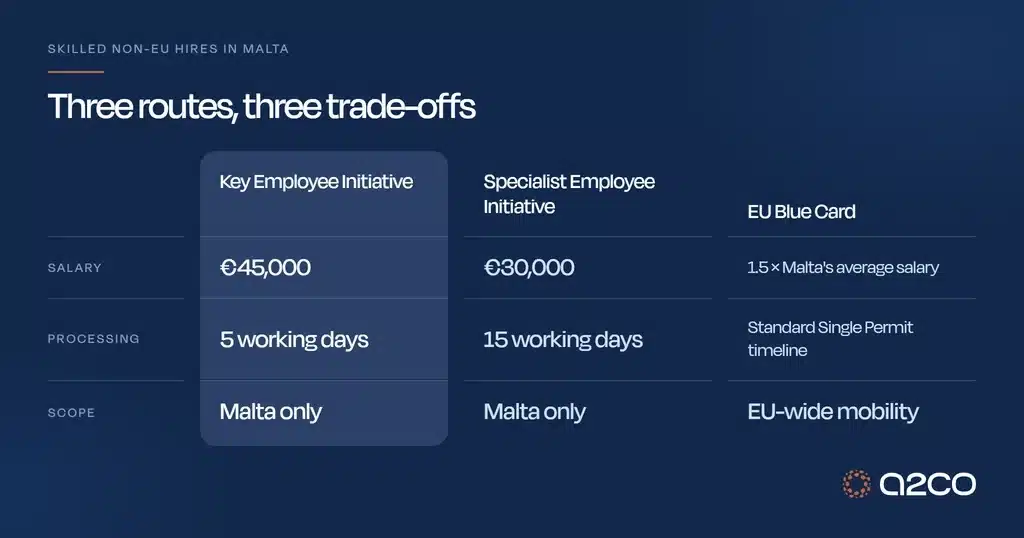
Malta runs three routes for highly skilled non-EU hires, and the right one depends mainly on salary, role level and whether EU mobility matters to the candidate.
| Key Employee Initiative | Specialist Employee Initiative | EU Blue Card | |
|---|---|---|---|
| Minimum salary | €45,000 gross a year | €30,000 gross a year | 1.5 times Malta’s average gross annual salary, updated each year |
| Roles | Managerial or highly technical | Specialist roles in ISCO groups 1 to 3 | Highly qualified employment |
| Qualifications | Relevant qualifications or experience | MQF Level 6, or a lower qualification plus three years’ relevant experience | Higher education or equivalent higher professional qualifications |
| Processing | Five to ten working days | Fifteen working days | Standard Single Permit timeline |
| Scope | Malta only | Malta only | EU-wide scheme with mobility rights |
The Specialist Employee Initiative is the fallback for specialist hires who do not meet the KEI salary or seniority test. The EU Blue Card suits candidates who may later want to move within the EU, but it carries its own qualification and contract-length requirements.
One difference that often decides the matter is family. According to Identità’s guidance for highly qualified individuals, KEI holders do not need to wait 12 months before applying for family reunification, provided they meet the salary, insurance and schooling requirements.
Where KEI Applications Usually Slow Down
Most avoidable delays come from preparation rather than from Identità’s assessment:
- Outdated thresholds. Offers drafted against the old €30,000 or €35,000 figures fall below the current €45,000 requirement.
- Advert outside the window. An advert that ran too early, or one that cannot be evidenced, can invalidate an otherwise strong file.
- Incomplete uploads. Missing documents stops the five to tenday clock from starting at all.
- Late qualification recognition. MQRIC recognition takes time and should be requested as soon as the candidate is identified, especially when there are no reference letters to be provided.
- Inconsistent job details. The title and duties in the contract, the position description, and the application form need to match word for word.
KEI and the Highly Skilled Individuals Tax Rules
The Key Employee Initiative decides whether someone can live and work in Malta. It does not decide how they are taxed.
Senior hires in regulated sectors may also want to look at Malta’s Highly Skilled Individuals rules, introduced in 2026, which provide a specific tax treatment for qualifying employment income. Eligibility depends on the function actually performed and on approval by the competent authority, so a KEI approval does not carry over automatically.
Planning both at the same time avoids a common mismatch, where the role is described one way for immigration purposes and another way for tax.
Hiring a senior non-EU professional? Check whether the role qualifies for the Key Employee Initiative before you advertise it.