Sanctions Risk Assessment for iGaming Operators in Malta
Sanctions risk assessment for iGaming operators in Malta is now a practical compliance issue for gaming businesses that may fall within the Article 32 framework.
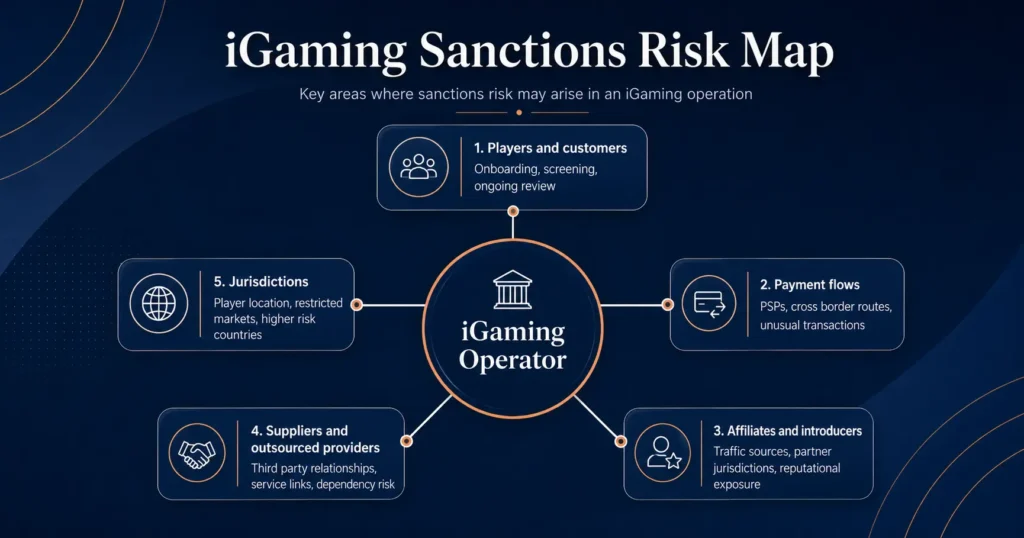
In gaming, sanctions risk can arise through players, payment flows, gameplay, agents, jurisdictions and operational relationships. A name check may be useful, but it does not always show how sanctions exposure could enter the business.
TLDR
- iGaming operators in Malta may need to assess sanctions exposure where their activities fall within the Article 32 framework.
- Sanctions risk can arise through players, payments, affiliates, suppliers, jurisdictions, gameplay and operational relationships.
- Player or customer screening is important, but it should not be treated as being compliant with the sanctions risk assessment obligation
- A2CO supports iGaming operators with compliance and governance support, including documentation review, risk assessment structure and gap analysis.
Why Article 32 Matters for iGaming B2C Operators in Malta
Article 32 applies to persons, entities and bodies listed in Schedule I of the National Interest framework.
For B2C gaming operators, the position should be assessed carefully. A B2C Operator is considered as a subject person under Maltese law, and would therefore fall in scope of Article 32 of the National Interest (Enabling Powers) Act.
This is why sanctions compliance for gaming operators in Malta should be treated as a practical governance matter, not only as a screening exercise.
Where Sanctions Risk Can Arise in Gaming Operations
Sanctions risk in gaming is often operational. It may appear through the people using the platform, the way money moves, or the relationships that support the business.
Areas to consider include:
- player and customer exposure
- payment methods and payment flows
- countries where players, customers or business partners are located
- affiliates, introducers and marketing partners
- suppliers and outsourced providers
- group structures and operational links
- changes in customer behaviour or business activity
- higher risk jurisdictions
This makes sanctions compliance for iGaming operators different from a generic policy review. The assessment should reflect how the operator actually works.
Player Sanctions Screening
Player sanctions screening in Malta may be relevant where the operator’s risk profile calls for it. B2C Gaming businesses have an obligation to screen players, and relevant connected parties where appropriate.
That said, customer sanctions screening within the gaming industry in Malta should sit within a wider risk framework. Screening may show whether a name appears on a list. It does not automatically explain whether the wider relationship, payment route or jurisdiction creates exposure.
Operators should also consider how checks are recorded. Where relevant, the file should show what was checked, what was found, what decision was taken and whether any follow up action was needed.
Payment Flows, Affiliates and Jurisdiction Risk
Payment flows within gaming deserves close attention, especially because it may carry with it sanctions risk. B2C Gaming operators may have customers in different markets, payment service providers in different countries and operational partners supporting parts of the business.
Risk may arise through cross border flows, payment routes, third party providers, affiliate relationships and jurisdictions linked to players or counterparties. A change in activity may also matter. For example, unusual payment behaviour, new traffic sources or a shift in the countries generating business may call for review.
Affiliates and introducers can affect where players come from and how the operator is exposed to certain markets. This does not mean every affiliate relationship creates a sanctions issue. It does mean the operator should understand the relationship and document the reasoning where risk is higher.
Targeted Financial Sanctions and Wider Risk Assessment

In Malta, targeted financial sanctions compliance should not be reduced to a name check.
A documented sanctions risk assessment should consider how exposure can arise across customers, services, jurisdictions, payments, affiliates and delivery channels. It should also explain how the operator identifies, reviews and escalates relevant concerns.
In B2C iGaming, AML and sanctions compliance may overlap, but they are not the same. AML controls often focus on money laundering and terrorist financing risk. Sanctions controls focus on restrictions linked to designated persons, entities, countries or activities. A strong AML framework can help, but it will not make a company compliant with the Sanctions Risk Assessment obligations.
For official context, operators should refer to the National Interest (Enabling Powers) Act, Sanctions Monitoring Board guidance, relevant MGA material and FIAU guidance for the remote gaming sector where applicable.
How A2CO Supports iGaming Operators
A2CO provides compliance and governance support for gaming businesses that need a clearer approach to Article 32 compliance.
We can support operators by:
- reviewing the current sanctions compliance approach
- helping structure a sanctions risk assessment
- mapping risks linked to players, payments, affiliates, jurisdictions and services
- reviewing documentation and governance gaps
- helping distinguish AML risk assessment from sanctions risk assessment
- supporting periodic review and updates
You may also find our pages on sanctions risk assessment support in Malta, Article 32 sanctions risk assessment in Malta, Malta gaming licence support, AML and KYC support and business risk assessment useful.
This article is for general information only and does not constitute legal advice. The application of Article 32 should be assessed based on the specific activities, structure and risk profile of the gaming operator.