Crypto Licence Europe: Comparing CASP Licensing in Malta, Spain, Lithuania and Other Key Jurisdictions
Choosing a jurisdiction within the European Union to operate your crypto business is an essential step to consider. The choice of jurisdiction is a strategic decision that affects how your business operates, scales, and is perceived.
While the regulation aims to create unified principles relating to crypto assets and service providers to be applied across the EU, the reality on the ground is more nuanced. Each jurisdiction applies MiCA within its own supervisory culture, timelines, and expectations.
In this guide, we compare key jurisdictions including Malta, Spain, Lithuania, Portugal, and Poland. The aim is to help you understand where each one stands and what that means in practice for your business.
How MiCA Impacts Crypto Licensing Across Europe
The Markets in Crypto-Assets Regulation (MiCA) introduces a harmonised legal framework for crypto asset service providers across the European Union.
Under MiCA, firms must obtain authorisation as a CASP before offering regulated services such as custody, exchange, or trading platforms. Once authorised, a CASP can operate across the EU using a passporting mechanism.
Each Member State within the EU adopts MiCA into their local legislative framework and it is the national competent authority of each member state who administer the authorisation process.
Each competent authority interprets requirements, reviews applications, and assesses risk based on its own supervisory approach. This means that two applications with similar profiles may experience very different timelines or scrutiny depending on the jurisdiction.
For a practical breakdown of how these rules apply, you can explore our MiCA Regulation advisory services.
Key Factors When Choosing a Crypto Licence Jurisdiction in Europe
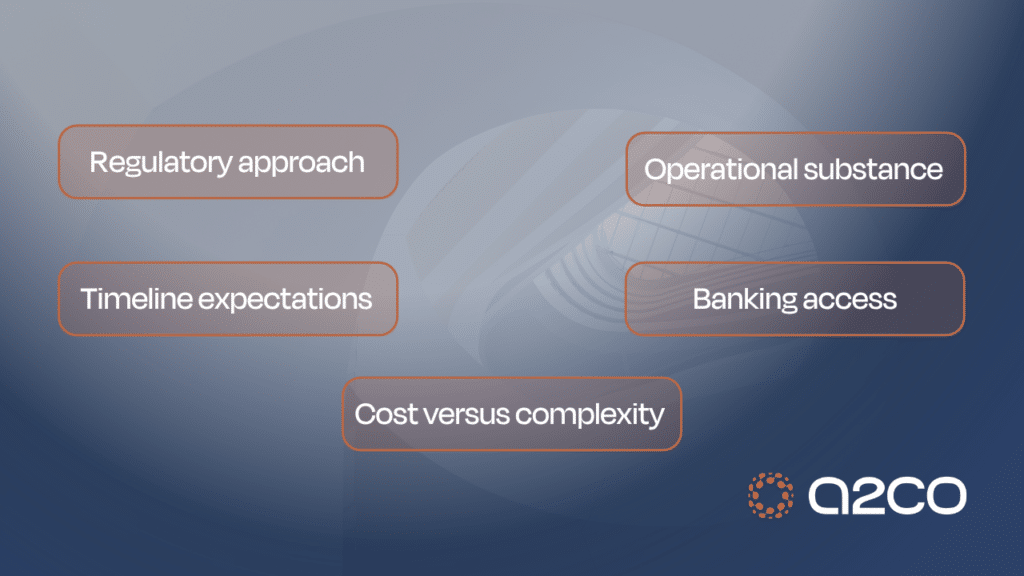
Selecting a jurisdiction is not only about regulatory approval. It shapes your operating model from day one.
Several factors should be assessed carefully.
Regulatory approach
Some authorities take a structured and detailed approach, focusing heavily on different aspects of governance.
Timeline expectations
Approval timelines vary. In practice, they depend not only on the regulator but also on the quality of your application.
Operational substance
Many jurisdictions expect a real presence, including local directors, compliance officers, and decision making within the country.
Banking access
A licence alone does not guarantee banking. Jurisdictions with stronger regulatory credibility often provide better access to financial institutions.
Cost versus complexity
Lower setup costs may come with higher long term operational risk if compliance expectations are underestimated.
This is where structured compliance support becomes essential. Services such as AML and KYC outsourcing and AML risk assessment often form part of a robust licensing strategy.
CASP Licence in Spain vs Malta
Spain has taken a measured approach to crypto regulation. The framework is shaped by national oversight through the CNMV, with a focus on investor protection and transparency.
You can review the regulator’s position on crypto asset regulation in Spain.
In practice, Spain tends to emphasise:
- clear disclosures to users
- strong governance frameworks
- alignment with financial market standards
Malta, by contrast, has built its position over several years through a dedicated regulatory framework for digital assets.
The CASP licence in Malta sits within a system that is already familiar with crypto operators. This often translates into clearer expectations around:
- governance structures
- compliance controls
- operational setup
The difference is not simply regulatory. It is also practical.
Spain may appeal to businesses seeking a large domestic market and alignment with traditional financial regulation. Malta is often chosen by firms that want a more defined process and a regulator experienced in digital assets.
CASP Licence in Lithuania vs Malta
Lithuania has positioned itself as a fast-moving jurisdiction in the crypto space.
Historically, it attracted firms through relatively quick setup processes and a straightforward entry point. Previously this has made the licence Lithuania route appealing for early-stage businesses.
With the adoption of MiCA, regulatory expectations have increased, particularly around compliance and substance.
You can review the approach taken by the central bank through its guidance on crypto-asset service providers in Lithuania.
Malta takes a more structured route from the outset.
While this can result in a longer preparation phase, it leads to a more stable operational foundation once authorised.
The key distinction is between speed and structure.
Lithuania may still offer faster entry in some cases. Malta focuses on building a compliant framework that can support long term growth.
Crypto Licence in Portugal vs Malta
Portugal has developed a reputation as a crypto friendly jurisdiction, particularly from a tax and innovation perspective.
However, regulatory clarity has evolved gradually. The framework is overseen by Banco de Portugal, which supervises registrations and compliance.
More information is available through its guidance on virtual asset service providers in Portugal.
For businesses exploring a crypto licence in Portugal route, the appeal often lies in:
- a supportive innovation environment
- a growing crypto ecosystem
- relatively accessible entry points
Malta offers a more established regulatory structure.
Rather than focusing on market perception alone, it provides a defined licensing pathway aligned with MiCA expectations.
This makes the choice less about which jurisdiction is more open, and more about which one provides the clarity your business needs.
CASP Licence in Poland vs Malta
Poland is developing its position within the MiCA framework.
The CASP licence in Poland route may appeal to businesses targeting Central and Eastern Europe, particularly those looking for proximity to specific markets.
At the same time, the regulatory environment is still evolving.
Compared to Malta, the framework is less mature in terms of crypto specific experience. This does not make it unsuitable, but it does introduce a degree of uncertainty that should be considered.
Malta remains more established in terms of process, expectations, and supervisory experience.
Which Crypto Licence Jurisdiction Is Right for Your Business
The right jurisdiction depends on your business model and your priorities.
Exchanges and trading platforms
These businesses often require strong regulatory credibility and reliable banking relationships. A structured jurisdiction is usually more suitable.
Custodians
Custody services involve higher levels of scrutiny. Jurisdictions with detailed supervisory frameworks tend to offer more clarity.
Startups
Early-stage firms may prioritise speed and cost. However, choosing a jurisdiction based only on these factors can create challenges later.
Established firms
Larger organisations typically focus on scalability, governance, and long term compliance.
In all cases, preparing a solid business plan is critical. You can explore how this fits into your strategy through our business plans and projections support.
Common Mistakes When Choosing a Crypto Licence in Europe
Several patterns appear repeatedly across applications.
Choosing based only on cost often leads to underestimating regulatory expectations. What appears cheaper at the start can become more expensive over time.
Compliance is another area that is frequently misunderstood. MiCA introduces detailed requirements around governance, risk management, and reporting. These cannot be treated as secondary considerations.
Substance requirements are also overlooked. Regulators expect real decision making and oversight within the jurisdiction, not just a registered address.
A more balanced approach considers both short term efficiency and long term sustainability.
How to Start a CASP Licence Application in Malta

Applying for a CASP licence requires structured preparation.
At a high level, the process involves:
- defining your business model and services
- preparing governance and compliance frameworks
- documenting operational procedures
- engaging with the regulator
A detailed overview of the CASP licence application process can help you understand what is expected at each stage.
You will also need to appoint key roles, including compliance and risk functions. These are outlined in the requirements for MFSA required positions.
The quality of preparation often determines how smoothly the process progresses.
How A2CO Supports CASP Licensing Across Europe
We support businesses throughout the licensing process, from early-stage structuring to regulatory engagement.
This includes:
- preparing application documentation
- building governance and compliance frameworks
- supporting ongoing regulatory requirements
For token issuers and related activities, understanding disclosure obligations is also important. You can explore this further through our guidance on MiCA white paper requirements.
Our role is to help you approach licensing in a way that is practical, structured, and aligned with your long-term objectives.
Final Note
A crypto licence in Europe is no longer just about regulatory approval. It defines how your business will operate, scale, and be assessed by partners and regulators.
Taking the time to choose the right jurisdiction can prevent costly adjustments later.