Sanctions Risk Assessment for Tax Advisors in Malta
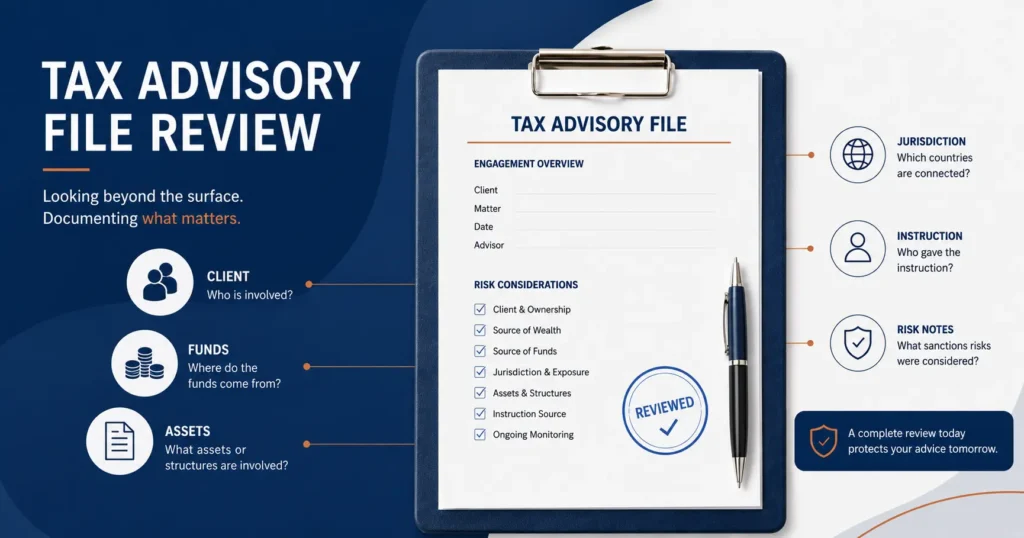
Sanctions risk assessment for tax advisors in Malta is now a practical issue for advisory firms that may fall within the Article 32 framework.
For tax advisors, sanctions risk is rarely only about checking a client name against a list. The more difficult questions usually sit behind the engagement. Where did the client’s wealth come from? Where are the funds held? Who gave the instruction? Are foreign assets, entities, family members or intermediaries involved? Has anything changed since the client was first accepted?
These points can affect how a tax advisory file should be documented.
Service Summary
Tax advisors in Malta need to consider a sanctions risk assessment as per Article 32 framework.
Sanctions risk in tax advisory work can arise through international clients, source of wealth, source of funds, cross border structures, asset transfers and client instructions from abroad.
Screening is important, but a clean result does not replace a documented sanctions risk assessment.
A2CO supports advisory firms with compliance and governance support, including documentation review, risk assessment structure and gap analysis.
Why Article 32 Matters for Tax Advisors in Malta
Article 32 applies to persons, entities and bodies listed in Schedule I of the National Interest framework. At the time of writing of this article, subject persons were listed in Schedule 1. Given that Tax Advisors are considered as Subject Persons, they fall under this obligation.
Not every tax matter carries the same level of sanctions risk. A local advisory file for a long-standing client will not usually raise the same questions as advice involving international ownership, foreign assets, relocation, succession planning, restructuring or cross border payments.
The key question is whether the firm can show that sanctions risk was considered where relevant. What was checked? What was understood about the client? What risks were present? Why was the instruction accepted or continued?
Where Sanctions Risk Can Arise in Tax Advisory Work
In tax advisory work, sanctions risk often appears through the facts of the matter.
A tax advisor may be asked to advise an international client, review a cross-border tax structure, support a relocation plan, assist with property related tax advice, advise on succession planning, or consider a restructuring, share transfer or dividend flow.
Additional risk may arise where instructions come through an intermediary, funds move from abroad, assets are held through foreign entities, or the client has links to a higher risk jurisdiction.
For tax advisory firms in Malta, the file should tell a clear story. It should show who is involved, what the advice relates to, where the money or assets come from, and whether any sanctions risk factors were relevant.
Cross Border Clients, Structures and Advisory Files
Sanctions risk in cross border tax advisory work can arise where advice involves more than one jurisdiction.
This may include international ownership, foreign entities, group structures, asset transfers, relocation or residence planning, property matters, inheritance planning or succession advice.
In these cases, the advisory file should show that relevant sanctions risk factors were considered where applicable. The level of review should reflect the facts, the client profile and the nature of the work.
For firms handling international matters, sanctions risk assessment support in Malta can help create a clearer and more consistent approach.
Screening Is Not the Same as a Sanctions Risk Assessment
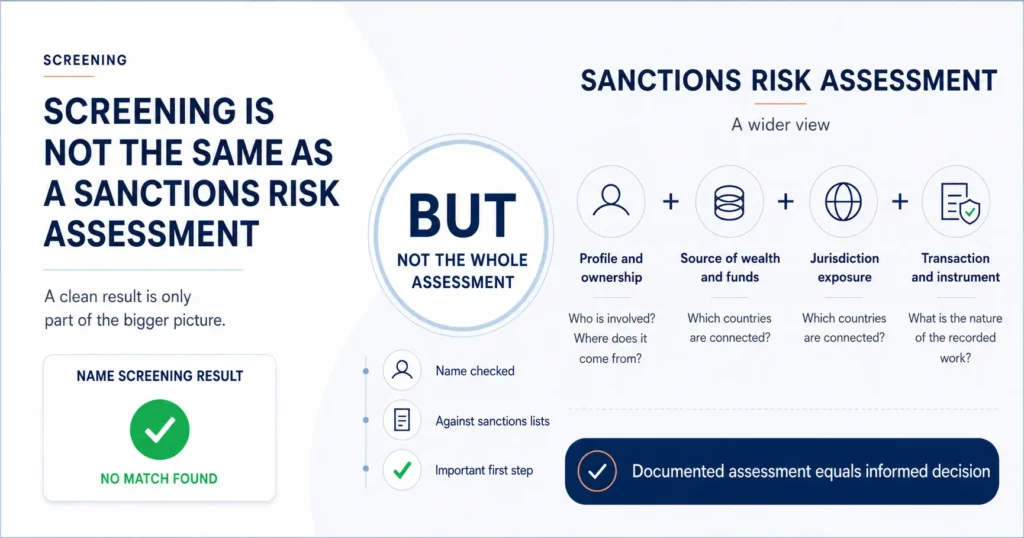
Screening is a control. It is not the whole assessment.
A sanctions risk assessment is a documented view of how sanctions exposure may arise across clients, services, jurisdictions, transactions and delivery channels.
A passed name check does not automatically mean the firm has assessed wider sanctions risk. The firm still needs to consider whether the client profile, source of wealth, source of funds, jurisdictional exposure or advisory instruction raises issues that should be recorded. The Sanctions Risk Assessment will analyse through a holistic view of all the relevant clients of the firm and assess the likelihood and impact of different possible scenarios. Through the combination of likelihood and impact, the inherent risk of scenarios are taken into consideration.
Mitigation testing for Sanctions risk, circumvention of sanctions risk and proliferation finance risk are required to be assessed within the Sanctions Risk Assessment. The mitigation level will determine the effect the mitigation will have on the inherent risk, which would result in the residual risk.
Therefore, the Sanctions Risk Assessment for Tax Advisors will have 3 final findings:
- The Inherent Risk Calculation of Sanctions Risk
- Mitigation Level when it comes to Sanctions Risk
- Residual Risk calculation of Sanctions Risk
And
- The Inherent Risk Calculation of Circumvention of Sanctions Risk
- Mitigation Level when it comes to Circumvention of Sanctions Risk
- Residual Risk calculation of Circumvention of Sanctions Risk
And
- The Inherent Risk Calculation of Proliferation Finance Risk
- Mitigation Level when it comes to Proliferation Finance Risk
- Residual Risk calculation of Proliferation Finance Risk
The above findings should be compared to the sectoral sanctions risk findings noted within the latest National Risk Assessment of Malta.
How A2CO Supports Tax Advisors with Sanctions Risk Assessments
A2CO provides compliance and governance support to tax advisors and professional firms in Malta.
We can help by reviewing the current approach, helping structure a sanctions risk assessment, mapping risks linked to client types, services, jurisdictions and advisory work, and reviewing documentation or governance gaps.
We also support firms that need to distinguish their AML business risk assessment from their sanctions risk assessment. For tax advisors, AML compliance in Malta and sanctions specific risk assessment work are connected, but they should not be treated as the same exercise.
Related support may include Article 32 sanctions risk assessment in Malta, tax advisory support and AML and KYC support.