Our Malta EMI Licence Services
We support clients across the full EMI licensing lifecycle, including:
- EMI licence application preparation and submission
- Regulatory advisory and MFSA introduction and liaison
- Business plan and financial projections
- Governance and organisational structuring
- AML and compliance framework design
- Risk management framework development
- Capital structuring support
- Post licensing compliance and regulatory support
EMI Licence Malta Requirements and Application Readiness
Our EMI licence services in Malta support businesses seeking authorisation to operate as electronic money institutions under the Malta Financial Institutions Act. To obtain an EMI licence, businesses must meet regulatory requirements set by the Malta Financial Services Authority, including governance, capital, and compliance obligations.
In practice, this means showing the regulator that your business is well structured and ready to operate in a compliant way. The MFSA will look beyond your idea and focus on how decisions are made, how risks are managed, and whether your financial assumptions are realistic.
For further regulatory context, you can refer to the official MFSA framework.

EMI Licence Malta Requirements, Process and Costs
What is an EMI Licence and How It Works?
A licenced Malta Electronic Money Institution Malta would be authorised to issue electronic money and provide payment services within a regulated environment.
Electronic money is simply digital value that represents funds. It is used in products such as prepaid cards, digital wallets, and online payment systems.
Unlike banks, EMIs do not lend money or take deposits in the traditional sense. Rather, their role is to facilitate payments and safeguard client funds. This distinction is important, as it shapes both the regulatory expectations and the operational model.
Across the European Union, EMIs are regulated under the Electronic Money Directive 2009/110/EC, which creates a consistent framework that allows authorised firms to operate across European borders.
EMI Licence Malta Requirements
Meeting EMI requirements Malta involves more than reaching minimum thresholds. The MFSA will assess whether the structure is credible, complete, and aligned with how the business will actually operate.
The starting point is capital. The licenced entity must hold at least €350,000 in initial capital, but the MFSA, being the regulator, will also consider whether this is sufficient for the specific model, and retains discretion to increase the threshold.
Governance is equally important. There is the need for clearly defined roles, experienced individuals, and a structure that supports proper oversight. If you want to understand how these roles are assessed in practice, our MFSA required positions guidance provides a clear breakdown.
Compliance is another key area. The AML framework must be practical and detailed, covering such areas as onboarding, monitoring, and reporting, amongst others. Many applicants underestimate how closely this is reviewed. Our AML and KYC outsourcing services can help you build tailored systems, models and procedures that meet regulatory expectations from the outset.
Risk management ties everything together. The applicant must demonstrate how risks are identified, documented, and managed on an ongoing basis.
Where applications often fall short is in the gap between documentation and reality. A structure may look correct on paper, but if it does not reflect how the business will function in practice, it opens doors to challenge. Our dedicated Internal Audit team members may be appointed to ensure the continuous adherence to MFSA-approved policies and procedures
EMI Licence Malta Application Process
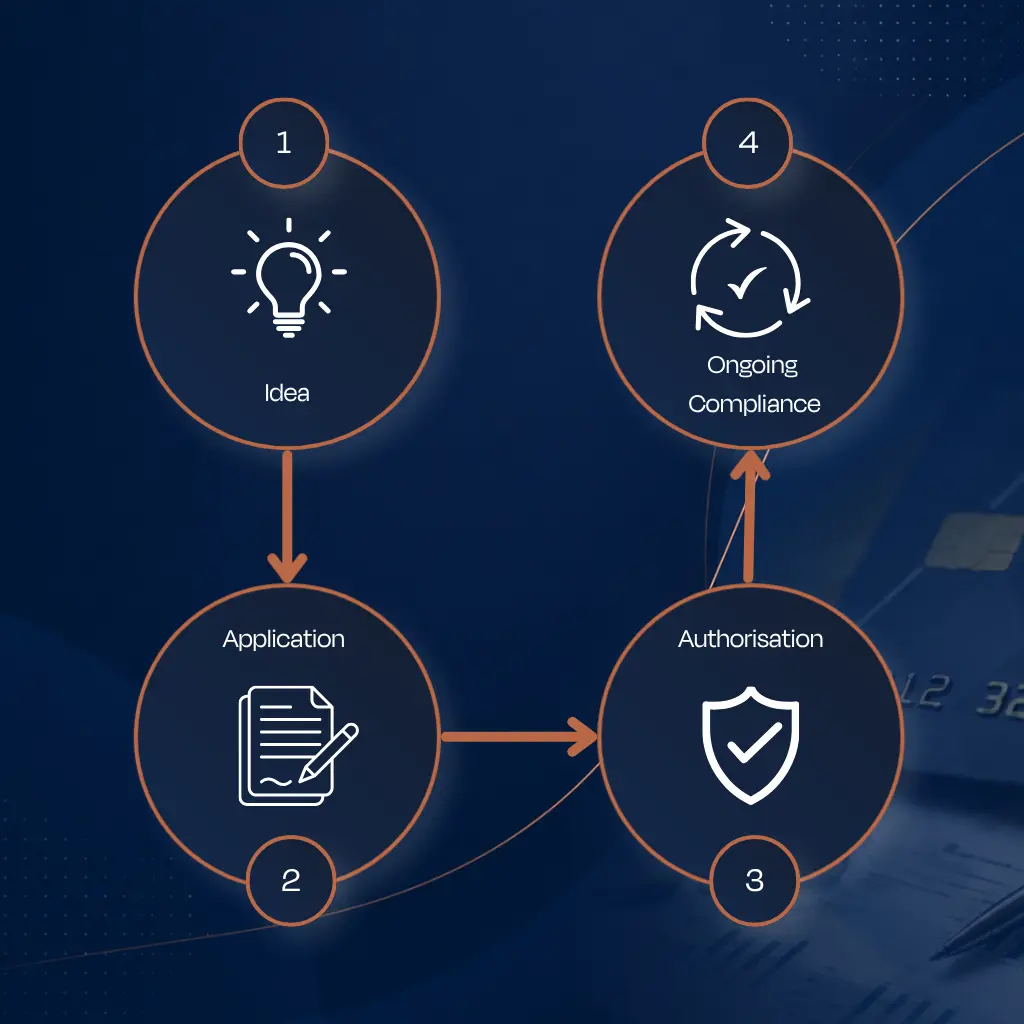
The application for a Malta EMI licence entails a process which follows a defined structure, but the outcome depends significantly on how well each stage is handled.
It begins with structuring and feasibility, where your business model, services, and regulatory scope are clearly defined in terms of a statement of intent and a high-level presentation to the MFSA. Subject to the MFSA’s green light to proceed with the formal application, or the attendance of a meeting with the MFSA as may be required, all stakeholders’ expectations are aligned, and the collation of application documents proceeds, towards submission.
Indeed, the most demanding stage is application preparation. This is where your governance framework, policies, and financial projections must come together into a coherent submission. Strong financial planning is critical here, and our business plan and financial projections support is often central to this stage.
Once submitted, the application enters regulatory review. The MFSA will assess the details carefully and raise questions where needed. This stage can take time, particularly if the entire set-up behind the operation is not yet formalised.
Finally, once all points are addressed, authorisation is granted.
Whilst timelines can vary, most applications take several months. Long delays are usually linked to weak documentation, unclear governance, or unrealistic assumptions. In many cases, getting the structure right early, including through proper Malta company formation support, makes a significant difference.
What is an EMI Licence and How It Works?
A licenced Malta Electronic Money Institution Malta would be authorised to issue electronic money and provide payment services within a regulated environment.
Electronic money is simply digital value that represents funds. It is used in products such as prepaid cards, digital wallets, and online payment systems.
Unlike banks, EMIs do not lend money or take deposits in the traditional sense. Rather, their role is to facilitate payments and safeguard client funds. This distinction is important, as it shapes both the regulatory expectations and the operational model.
Across the European Union, EMIs are regulated under the Electronic Money Directive 2009/110/EC, which creates a consistent framework that allows authorised firms to operate across European borders.
EMI Licence Malta Requirements
Meeting EMI requirements Malta involves more than reaching minimum thresholds. The MFSA will assess whether the structure is credible, complete, and aligned with how the business will actually operate.
The starting point is capital. The licenced entity must hold at least €350,000 in initial capital, but the MFSA, being the regulator, will also consider whether this is sufficient for the specific model, and retains discretion to increase the threshold.
Governance is equally important. There is the need for clearly defined roles, experienced individuals, and a structure that supports proper oversight. If you want to understand how these roles are assessed in practice, our MFSA required positions guidance provides a clear breakdown.
Compliance is another key area. The AML framework must be practical and detailed, covering such areas as onboarding, monitoring, and reporting, amongst others. Many applicants underestimate how closely this is reviewed. Our AML and KYC outsourcing services can help you build tailored systems, models and procedures that meet regulatory expectations from the outset.
Risk management ties everything together. The applicant must demonstrate how risks are identified, documented, and managed on an ongoing basis.
Where applications often fall short is in the gap between documentation and reality. A structure may look correct on paper, but if it does not reflect how the business will function in practice, it opens doors to challenge. Our dedicated Internal Audit team members may be appointed to ensure the continuous adherence to MFSA-approved policies and procedures
EMI Licence Malta Application Process
The application for a Malta EMI licence entails a process which follows a defined structure, but the outcome depends significantly on how well each stage is handled.
It begins with structuring and feasibility, where your business model, services, and regulatory scope are clearly defined in terms of a statement of intent and a high-level presentation to the MFSA. Subject to the MFSA’s green light to proceed with the formal application, or the attendance of a meeting with the MFSA as may be required, all stakeholders’ expectations are aligned, and the collation of application documents proceeds, towards submission.
Indeed, the most demanding stage is application preparation. This is where your governance framework, policies, and financial projections must come together into a coherent submission. Strong financial planning is critical here, and our business plan and financial projections support is often central to this stage.
Once submitted, the application enters regulatory review. The MFSA will assess the details carefully and raise questions where needed. This stage can take time, particularly if the entire set-up behind the operation is not yet formalised.
Finally, once all points are addressed, authorisation is granted.
Whilst timelines can vary, most applications take several months. Long delays are usually linked to weak documentation, unclear governance, or unrealistic assumptions. In many cases, getting the structure right early, including through proper Malta company formation support, makes a significant difference.
EMI Licence Malta Capital and Cost Considerations
Understanding the cost of obtaining an EMI licence from Malta early on helps set realistic expectations and avoids issues later in the process.
The initial capital requirement is €350,000, which must be fully paid and clearly evidenced. Beyond this, there are application and supervisory fees, which depend on the scale of the business.
Operational costs also need to be considered. These include staffing, relocation of people from foreign group entities, compliance systems, reporting obligations, and audit requirements.
Professional support is another factor. Preparing a strong application and maintaining compliance after authorisation requires ongoing input, particularly in regulated environments.
Taking a realistic view of these costs is not just helpful for planning. It also strengthens your application, as the MFSA will expect to see a sustainable financial model.

EMI Licence Malta Benefits and Comparison with Payment Institution Licence
Benefits of an EMI Licence in Malta
An EMI licence from the MFSA provides access to the European payments market within a recognised regulatory framework.
Once authorised, the licensee can passport its services across the EU, allowing the licenced operations in multiple jurisdictions without the requirement of obtaining separate licences.
Malta also offers a well-established regulatory environment, which provides credibility when dealing with partners, banks, and clients.
For businesses targeting international markets, Malta continues to serve as a practical entry point into Europe.
EMI Licence Malta vs Payment Institution Licence
The distinction between an EMI and a Payment Institution licence is often misunderstood, but it is important to get this right from the start. Indeed, it has become particularly important following recent regulatory and judicial guidance on what qualifies as electronic money.
An EMI licence is generally required where a business issues a distinct electronic monetary value that is separate from the funds received, can be transferred between users, and can be accepted and held by third parties as e-money itself. This would typically apply where the product creates stored electronic value, such as certain wallet or stored-value models.
A Payment Institution licence, on the other hand, may be more appropriate where the business is facilitating payment transactions, processing transfers, or safeguarding client funds for the execution of payments, without issuing a separate transferable electronic monetary value.
This distinction should be assessed carefully at the structuring stage to ensure that the activity does not fall outside of scope of EMI and instead is closer to payment services.
The regulatory framework for both EMIs and payment institutions is also expected to change under the forthcoming PSD3 and PSR requirements for payment firms, including potential implications for authorisation, safeguarding, governance and licence transition.
For a broader view of licensing options, you can explore our financial services advisory services.
Benefits of an EMI Licence in Malta
An EMI licence from the MFSA provides access to the European payments market within a recognised regulatory framework.
Once authorised, the licensee can passport its services across the EU, allowing the licenced operations in multiple jurisdictions without the requirement of obtaining separate licences.
Malta also offers a well-established regulatory environment, which provides credibility when dealing with partners, banks, and clients.
For businesses targeting international markets, Malta continues to serve as a practical entry point into Europe.
EMI Licence Malta vs Payment Institution Licence
The distinction between an EMI and a Payment Institution licence is often misunderstood, but it is important to get this right from the start. Indeed, it has become particularly important following recent regulatory and judicial guidance on what qualifies as electronic money.
An EMI licence is generally required where a business issues a distinct electronic monetary value that is separate from the funds received, can be transferred between users, and can be accepted and held by third parties as e-money itself. This would typically apply where the product creates stored electronic value, such as certain wallet or stored-value models.
A Payment Institution licence, on the other hand, may be more appropriate where the business is facilitating payment transactions, processing transfers, or safeguarding client funds for the execution of payments, without issuing a separate transferable electronic monetary value.
This distinction should be assessed carefully at the structuring stage to ensure that the activity does not fall outside of scope of EMI and instead is closer to payment services.
The regulatory framework for both EMIs and payment institutions is also expected to change under the forthcoming PSD3 and PSR requirements for payment firms, including potential implications for authorisation, safeguarding, governance and licence transition.
For a broader view of licensing options, you can explore our financial services advisory services.
Why Choose A2CO for EMI Licence Malta
We focus on helping you present a complete and licence-ready application, not just a technically correct one.
That means aligning your business model, governance, and financial planning into a structure that the regulator can clearly understand and assess, with comfort of its suitability for the regulator.
Because we work across corporate, compliance, and financial advisory, we can support the process end to end. This reduces delays, avoids gaps, and gives you a clearer path to EMI authorisation Malta.
EMI Licence Malta Frequently Asked Questions
Most applications take several months. The timeline depends on how well prepared the submission is and how quickly any regulatory questions are addressed.
Yes. Once authorised, you can expand into other EU countries through a notification process.
The minimum is €350,000. However, the MFSA will also assess whether this is sufficient for your specific business model.
Yes, but these funds must be safeguarded. They must be kept separate from the company’s own funds and protected in line with regulatory requirements.
Starting your application requires clarity.

Partner

Partner
"*" indicates required fields