Licensing Implications in Malta for Crypto Exchange License: How It Works Under MiCA
Malta Crypto Exchange Licence: Quick Overview
- Crypto exchanges in Malta require CASP authorisation under MiCA
- The previous VFA licence framework is no longer applicable
- The type of authorisation depends on the services offered, not the label “exchange”
- Most exchange models fall within scope and require approval before operating
- The process involves regulatory approval, governance setup, and compliance frameworks
- Once authorised, firms can operate across the EU via passporting
- Preparation and structuring are critical to avoid delays or rejection
Businesses looking to launch a crypto exchange in Malta must now operate under the EU’s Markets in Crypto Assets Regulation. In practice, this means obtaining authorisation as a crypto asset service provider, rather than applying for a standalone “crypto exchange licence”.
The regulatory outcome depends on the services offered, how the platform interacts with clients, and how the business is structured from a compliance perspective.
While MiCA establishes a unified EU framework, authorisation and supervision in Malta are handled by the Malta Financial Services Authority.
This article explains how the framework applies in practice, what activities may require authorisation, and what businesses should expect in terms of process, cost, and compliance.
How Crypto Exchange Licensing Works in Malta Under MiCA
The concept of a Malta Crypto Exchange License must be understood within the EU’s Markets in Crypto Assets Regulation, which applies across Member States from 30 December 2024.
Malta has implemented MiCA through the Markets in Crypto Assets Act, Chapter 647, with the Malta Financial Services Authority acting as the competent authority responsible for authorisation and supervision.
MiCA does not introduce a standalone “crypto exchange licence”. Instead, it regulates specific crypto asset services. Businesses that fall within scope must obtain authorisation as a crypto asset service provider.
This shift matters. It means the regulatory outcome depends on the services offered rather than the label attached to the business.
For a detailed breakdown of how this applies in practice, see our CASP licence in Malta.
You can also refer to the official EU framework here: Markets in Crypto Assets Regulation on EUR-Lex
Which Crypto Exchange Activities Require Authorisation in Malta?
Whether a crypto exchange requires authorisation depends on what it actually does.
Under MiCA, the following activities are commonly relevant:
- Exchange of crypto assets for funds
- Exchange of crypto assets for other crypto assets
- Operation of a trading platform for crypto assets
- Execution of orders on behalf of clients, where applicable
The distinction is important. Two platforms that both describe themselves as “exchanges” may fall under different regulatory scopes depending on their structure.
For example, a platform facilitating trades between users is treated differently from one trading on its own account without a client relationship.
As a result, businesses planning to start a crypto exchange in Malta need to define their model carefully before considering licensing.
Key Requirements for Crypto Exchanges Under MiCA
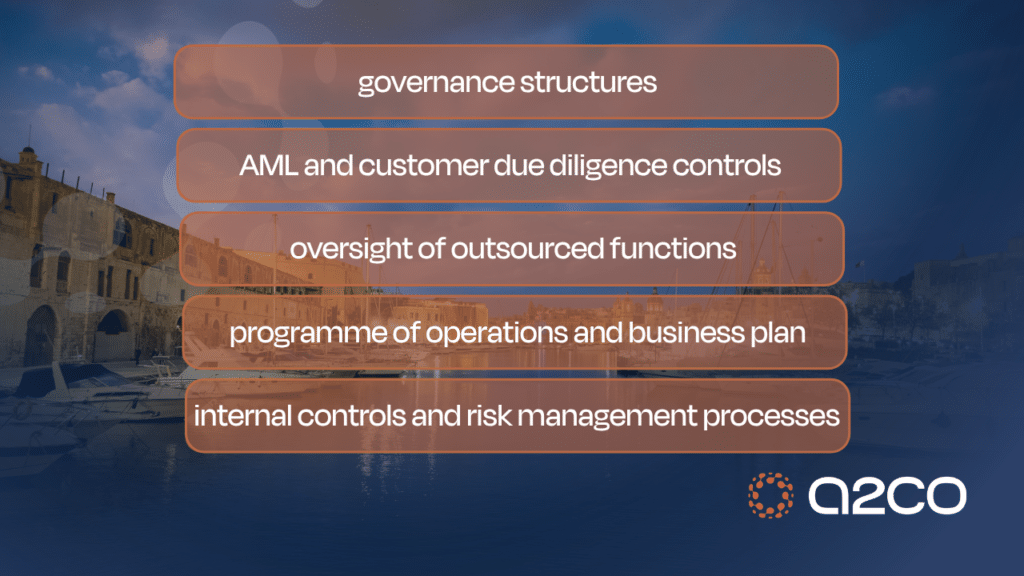
Authorisation under MiCA is not limited to a single application form. It involves demonstrating that the business can operate in a controlled and compliant way.
At a high level, this includes:
- Governance structures with clearly defined responsibilities
- Anti-money laundering and customer due diligence controls
- Oversight of outsourced functions
- A detailed programme of operations and business plan
- Internal controls and risk management processes
Regulators will assess whether the business model is credible, whether risks are understood, and whether the organisation has the capacity to manage them.
This is not a light touch process. ESMA has made it clear that there are no low risk CASP applications, and that governance, outsourcing, and business plans are central to the assessment.
From a practical perspective, areas such as onboarding and transaction monitoring often require structured support. Services like KYC in crypto solutions and AML and KYC outsourcing services can help ensure that compliance frameworks are properly implemented rather than treated as a formality.
Documentation also plays a central role. Clear policies and procedures are expected, particularly around financial crime controls. For example: AML policy drafting and procedures manuals For broader regulatory alignment, you can also explore MiCA regulation services.
Step-by-Step Process to Get Authorised in Malta
The application process follows a structured path, but the complexity depends on the business model and scope of services.
In most cases, the process includes:
- Defining the services and regulatory perimeter
- Preparing the application pack and supporting documents
- Submitting the application pack to the Malta Financial Services Authority
- Responding to regulatory queries and feedback
- Preparing for authorisation and operational readiness
The quality of preparation has a direct impact on timelines and outcomes. Weak or inconsistent documentation often leads to delays.
A strong application is not only about compliance. It must show how the business will operate in practice, including governance, financial planning, and risk management.
This is where structured financial planning becomes relevant.
Business plans and projections for licensing help demonstrate that the model is viable and aligned with regulatory expectations.
How Much Does a Malta Crypto Exchange Licence Cost?
The cost of a Malta Crypto Exchange License is not fixed. It varies depending on the structure, scale, and complexity of the business.
Key cost drivers include:
- Regulatory and advisory support during the application phase
- Legal structuring and corporate setup
- Development of compliance frameworks and documentation
- Internal staffing, including compliance and risk roles
- Technology infrastructure and operational systems
- Ongoing reporting, monitoring, and audit requirements
Businesses often underestimate the ongoing component. Authorisation is only the starting point.
Ongoing compliance, governance, and operational controls form a continuous cost base, especially for firms providing multiple regulated services.
For companies entering the market, early planning of both setup and operating costs is essential to avoid delays later in the process.
Why Businesses Choose Malta for Crypto Exchange Projects
Malta continues to attract interest from crypto businesses, particularly those seeking an EU base under MiCA.
The main considerations include:
- Access to the EU market through passporting
- A regulator familiar with digital asset structures
- A clear legal framework aligned with EU requirements
That said, Malta is not a shortcut. The focus remains on substance, governance, and operational readiness.
For many businesses, the process begins with establishing a local entity.
Malta company formation services provide the foundation for building a compliant structure within the jurisdiction.
Common Mistakes When Planning a Crypto Exchange in Malta
Several issues tend to come up repeatedly when businesses approach crypto exchange projects.
One is relying on outdated terminology. Treating “crypto exchange licence” as a fixed concept often leads to incorrect assumptions about requirements.
Another is underestimating compliance. MiCA places significant weight on governance, AML controls, and operational resilience. These are not secondary considerations.
Documentation is another weak point. Applications that lack clarity or consistency tend to face delays or additional scrutiny.
Outsourcing is also misunderstood. While it is permitted, it must be properly structured and cannot replace internal oversight.
Finally, some businesses focus heavily on the application stage and overlook post authorisation obligations. Ongoing compliance is a core part of operating under MiCA.
How A2CO Can Support Your Malta Crypto Exchange Project
Launching a crypto exchange in Malta requires more than regulatory awareness. It requires coordination across legal, compliance, and operational areas.
A2CO supports businesses by helping define the correct regulatory scope, aligning the business model with MiCA requirements, and preparing for authorisation in a structured way.
This includes support with governance frameworks, compliance design, and application readiness, as well as coordination across related areas such as company formation and ongoing compliance.
If you are assessing whether your exchange model falls within MiCA authorisation in Malta, A2CO can help you understand the regulatory perimeter and prepare for a compliant setup.